A practical music theory companion
Music Theoryfor Persian Ney
Explore the foundations of music theory here. Continue your ney practice with the Persian Ney PDF Book, featuring step-by-step instruction, fingering charts and practical exercises.
Begin here / One idea at a time
Your first steps
in reading music
Start with the symbols, learn a few notes and practise a short pattern. You do not need to understand every key signature before you begin.
What are you looking at?
Choose a symbol to locate it in this one-bar example
The treble clef establishes G4 on the second line from the bottom. It gives the staff its pitch reference.
01 / Connect the symbols
A note you can see
A sound you can hear
Tap a key to see its name, frequency and position on the treble staff. Change the range to explore lower and higher octaves.
Staff notation loads as you reach this section
The white key immediately to the left of a pair of black keys is C (Do). This page uses fixed-Do names: C–D–E–F–G–A–B = Do–Re–Mi–Fa–Sol–La–Si. Octave numbers follow scientific pitch notation, with middle C called C4.
Make the distinction
Pitch, duration and volume
Pitch tells you how high or low a note sounds. Duration tells you how long it lasts. Dynamics describe its loudness and shape. Changing one does not automatically change the others.
Follow the motion
Repeats, steps and skips
A repeated note stays on the same staff position. A step moves to the neighbouring line or space. A skip passes over one or more staff positions. Notice the pattern as well as each note name.
Try a step-and-skip patternKeep a comfortable pace
Tempo and a steady beat
Tempo sets how quickly the beat moves. At quarter note = 60 BPM, one quarter-note beat lasts one second. Begin slowly enough to read accurately, then raise the tempo gradually.
Hear different note lengthsRead the staff
The treble staff has five lines. From bottom to top, the lines are E–G–B–D–F; the spaces are F–A–C–E. Ledger lines continue the pattern above or below the staff.
Sharps, flats & naturals
A sharp raises a note by a semitone; a flat lowers it by a semitone. A natural cancels an alteration. On this equal-tempered keyboard, C♯ and D♭ share a pitch, though their musical spelling differs.
What does 440 mean?
A4 = 440 Hz sets the reference pitch. It does not make every note 440 Hz. An octave higher doubles the frequency; an octave lower halves it.
02 / Turn recognition into a skill
Read a note
Build your confidence
Learn with the name visible, then hide it and test yourself. Identify the written note name; octave numbers appear in the explanation after you answer.
Learn at your own pace
Say the name, notice its position, then listen to the note
Use the treble clef as your reference. In the key-signature levels, read the signature too: an F in G major sounds as F♯ even without a sharp beside that note. First-attempt accuracy counts questions answered correctly before a wrong answer, hint or reveal. No microphone is needed.
Read · Sing · Follow
Put the notes into a phrase
Ready · Say the names before pressing Play
First read the names slowly. Then hide the names and follow the staff. The playback leaves a small space between tones for clarity; every note still starts on its quarter-note beat. A teacher can help you connect the phrase on your ney.
03 / Give sound a length
Notes, rests
and the space between
A note shows a sound’s duration. A rest shows silence for the same length of time. Compare the symbols, then listen to a sound and watch its duration unfold.
The sound is a sustained A4 demonstration. The equivalent rest lasts just as long and is silent. Beats here always mean quarter-note beats; other meters may use a different main beat.
Make the counting meaningful
The beat gives values a context
A dot adds half
A dotted half lasts 3 quarter-note beats. A dotted quarter lasts 1½. A duration dot sits beside the note. A dot above or below the notehead can instead indicate staccato, an articulation marking.
A tie adds durations
A tie connects notes of the same pitch into one sustained sound. A slur connects a musical phrase and does not add note values together.
How do time signatures fit in?
In 3/4, a bar contains three quarter-note units. In 6/8, it contains six eighth-note units, usually grouped as two dotted-quarter beats. The lower number names the written unit; the main beat depends on the meter and musical context.
Triplets divide a span into three equal parts in place of two of the same written value. Three eighth-note triplets, for example, fit into one quarter-note beat. Ordinary groups of three eighths in 6/8 are not automatically triplets.
04 / Listen to the distance
Two notes
A musical relationship
An interval describes the distance between two pitches. Its number follows letter names; its quality describes the specific size. Hear the notes one after another or together.
The name counts both letter endpoints: C–D–E spans a third. C–E♭ is a minor third; C–E is a major third. F♯ and G♭ can sound alike here while spelling different intervals from C: an augmented fourth and a diminished fifth.
05 / Recognise the pattern
A scale is more
than a row of notes
A scale organises pitches around a starting note, the tonic. Compare major and natural minor patterns, then hear the same pattern beginning on a different tonic.
W = whole step, two semitones. H = half step, one semitone. Accidentals are written explicitly in this preview. Note spelling follows the scale, so each letter name appears once before the octave; an occasional double flat is intentional.
Why compare major and natural minor?
These patterns provide a clear introduction to scale construction. Natural minor has the pattern W–H–W–W–H–W–W. Harmonic and melodic minor alter some degrees for particular musical purposes; they are not included in this two-pattern explorer.
A scale alone does not define a Persian dastgah. Melodic movement, important notes, characteristic phrases and intonation all matter.
06 / Know what changes before you play
Make sense
of a musical key
The key helps organise music around a home note, called the tonic. Its signature tells you which note names normally take sharps or flats. Choose a familiar key first and follow the explanation.
The minor examples here use the natural minor scale. Harmonic minor raises its seventh degree. In the classical melodic minor form, the sixth and seventh degrees rise when ascending; descending normally returns to natural minor. These changes are written as accidentals beyond the key signature.
C major uses C, D, E, F, G, A and B. Its key signature has no sharps or flats.
Hear what changes
Major and relative minor
C major and A minor share a key signature. C is the tonic of C major; A is the tonic of A minor.
Key and ney tuning
A musical key describes the music’s pitch organisation. A ney tuning name identifies the instrument by a reference fingering. Learning a key includes its notes and phrases, whatever instrument you use.
How do I recognise a key signature?
Sharps come in this order
For a sharp major key, the last sharp is one semitone below the tonic. In D major, the last sharp is C♯; the tonic is D.
Flats come in this order
With two or more flats, the second-to-last flat names the major key. B♭ and E♭ give B♭ major. Learn the one-flat exception separately: F major.
A major key and its relative minor share a signature, but the musical context tells you the tonic. A local accidental normally lasts to the end of its bar for the same written pitch and octave. Harmonic or melodic minor may add accidentals beyond the signature.
07 / Bring theory back to the ney
The notation is a guide
Your ear completes the picture
The keyboard and audio tools on this page use twelve-tone equal temperament with A4 = 440 Hz. They help explain general notation and pitch relationships. Persian music also uses intervals and inflections that this keyboard cannot fully represent.
Koron and sori are additional accidental signs used in Persian notation. Develop their sound through close listening, repertoire and guidance rather than assuming that every pitch is a fixed piano key or an identical quarter-tone step.
On the ney, connect what you read with fingering, breath, register and phrase. Work with a short musical example, sing or imagine it, and then bring the sound to the instrument.
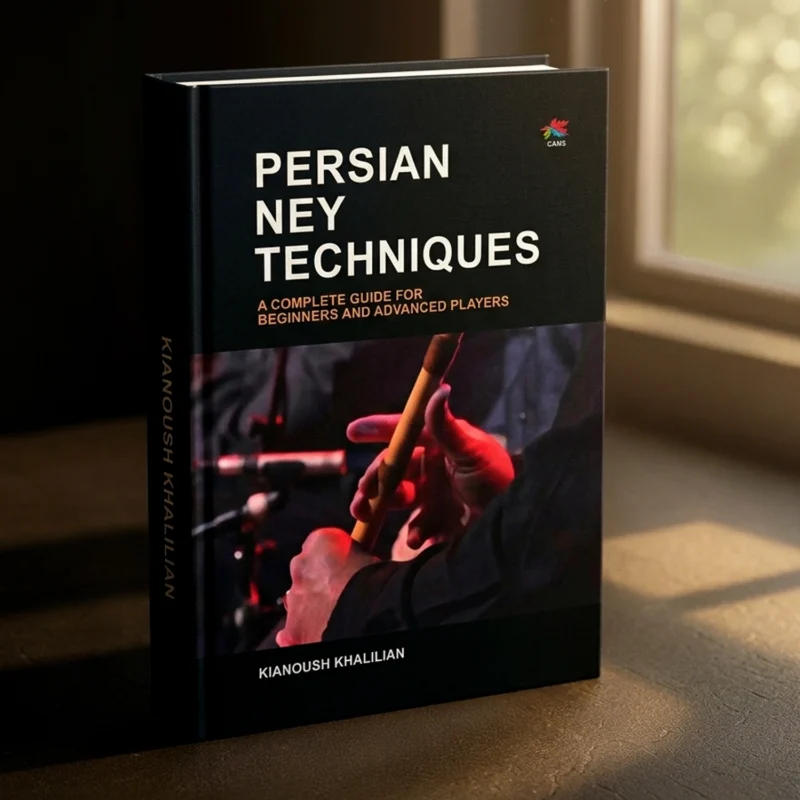
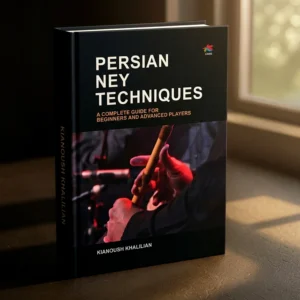
Your next step in Persian ney
Persian Ney
PDF Book
Build on these foundations with a practical guide to Persian ney, from your first sound to advanced playing.
- Sound production, tone and breath control
- Fingering charts and practical exercises
- Playing techniques and musical expression
English & Farsi · Digital edition · Instant download
Get the PDF BookFor a focused session: explore a note, compare one interval, read a short pattern, then return to your ney. A few clear connections are more useful than rushing through every tool.